






















Government Steps Up Preparations to Protect Farmers Amid Possible El Niño Impact on Monsoon
With rainfall running below normal and El Niño concerns growing, the Centre has launched a series of measures to help farmers manage the upcoming Kharif season, including crop planning, insurance coverage and advisory support

Fears are growing that El Niño may affect the monsoon this year, and the central government has begun taking safety measures to safeguard farmers and reduce the impact of possible crop losses in the important Kharif season.
Union Agriculture Minister Shivraj Singh Chouhan said the government was preparing for a worst-case scenario and zeroing in on specific districts that could face a major deficit in rainfall.
Measures to counter dry spell feared Measures to counter dry spell feared
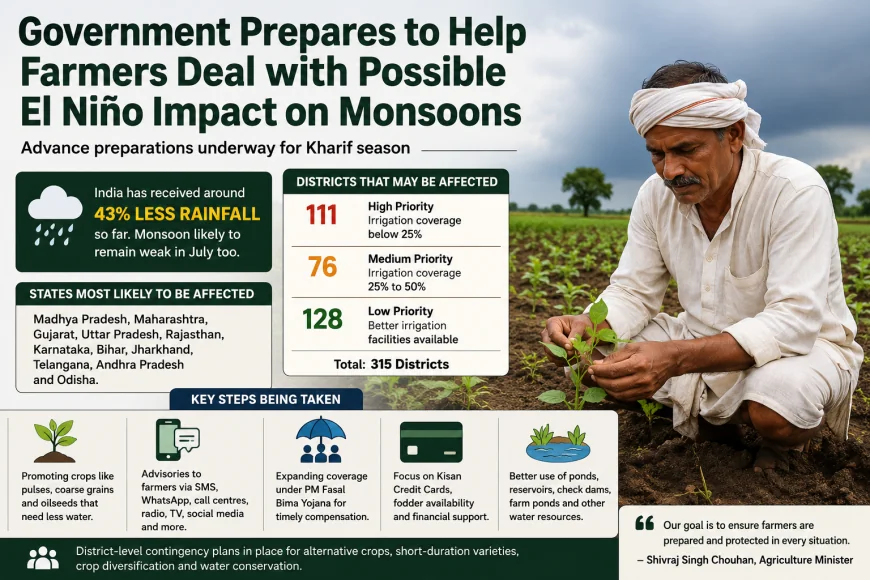
Speaking from New Delhi, Chouhan revealed a grim fact – the country has already registered a whopping 43% deficit in normal rainfall, and the weather office predictions offer little hope for July either. Speaking from New Delhi, Chouhan revealed a grim fact – the country has already registered a whopping 43% deficit in normal rainfall, and the weather office predictions offer little hope for July either.
Currently, around 315 districts are in the danger zone for below normal rains, according to current data. Currently, around 315 districts are in the danger zone for below normal rains, according to current data. Of these, 111 districts have been identified as highly vulnerable due to lack of adequate irrigation infrastructure, and the rest are being classified based on whatever little water access is left. Of these, 111 districts have been identified as highly vulnerable due to lack of adequate irrigation infrastructure, and the rest are being classified based on whatever little water access is left. Most of these high-risk zones are in the agriculture heartlands of India, starting from Madhya Pradesh, Maharashtra, Gujarat, Uttar Pradesh, Rajasthan, Karnataka, Bihar, Jharkhand, Telangana, Andhra Pradesh and Odisha. Most of these high-risk zones are in the agriculture heartlands of India, starting from Madhya Pradesh, Maharashtra, Gujarat, Uttar Pradesh, Rajasthan, Karnataka, Bihar, Jharkhand, Telangana, Andhra Pradesh and Odisha.
Advocating for Tougher, Water-Saving Crops
State governments have been urged to aggressively promote “thirsty-less” options such as pulses, oilseeds and coarse grains to help farmers adapt to a more and more fickle sky. These are hardy varieties that are inherently constructed to prosper in drier, tougher soil conditions. In the background, the central government is working with local state authorities to smooth out micro-level crop maps so that backup plans can be triggered instantly in case the rains fail completely.
Turning on the Digital Lifeline
They use a complex communication system so no farmer has to be in the dark about changing weather cycles or survival skills. Essential counselling is being disseminated through Krishi Vigyan Kendras, agrometeorological stations, SMS alerts, WhatsApp blasts, dedicated call centres, radio programmes, TV broadcasts and social media. The objective is straightforward: to give farmers actionable intelligence to enable them to make informed, real-time decisions on sowing, water management and crop care.
Reinforcing Financial Defence Lines
The government is creating a financial shield for rural communities in addition to field tactics. Chouhan said that teams were working double-time to fast-track enrolment into the Pradhan Mantri Fasal Bima Yojana (the national crop insurance scheme) across the worst-hit districts, guaranteeing a financial payout if crops wither away. Simultaneously, efforts are also on to ease the flow of credit through Kisan Credit Cards and build up stocks of animal fodder to prevent livestock dying of starvation in drought-hit areas.
Kick Start Bespoke Contingency Frameworks
Individual districts have created their own contingency plans instead of using a single, one-size-fits-all approach. These plans favour the use of short-duration seeds that grow quickly, crop diversification and making absolute maximum use of every available drop of water in the community ponds, reservoirs, check dams and farm collection pits. Officials hope that such targeted interventions will greatly reduce the impact on overall food production and rural livelihoods.
The government said it will not wait to see what the monsoon actually produces this year but will act in the coming weeks. Early strategy, fast-paced communication and financial buffers are hoped by authorities to see the agriculture sector through what could be a brutal season for millions of farming families who rely on seasonal rains for their entire year.
What's Your Reaction?
 Like
1
Like
1
 Dislike
0
Dislike
0
 Love
0
Love
0
 Funny
0
Funny
0
 Angry
0
Angry
0
 Sad
0
Sad
0
 Wow
1
Wow
1