




























Milky Way May Have Flipped After Collision With Dwarf Galaxy 10 Billion Years Ago
Durham University researchers say a head-on collision with the Gaia-Sausage-Enceladus dwarf galaxy may have flipped the Milky Way’s disc by more than 90 degrees around 10 billion years ago.

A Cataclysmic Cosmic Collision
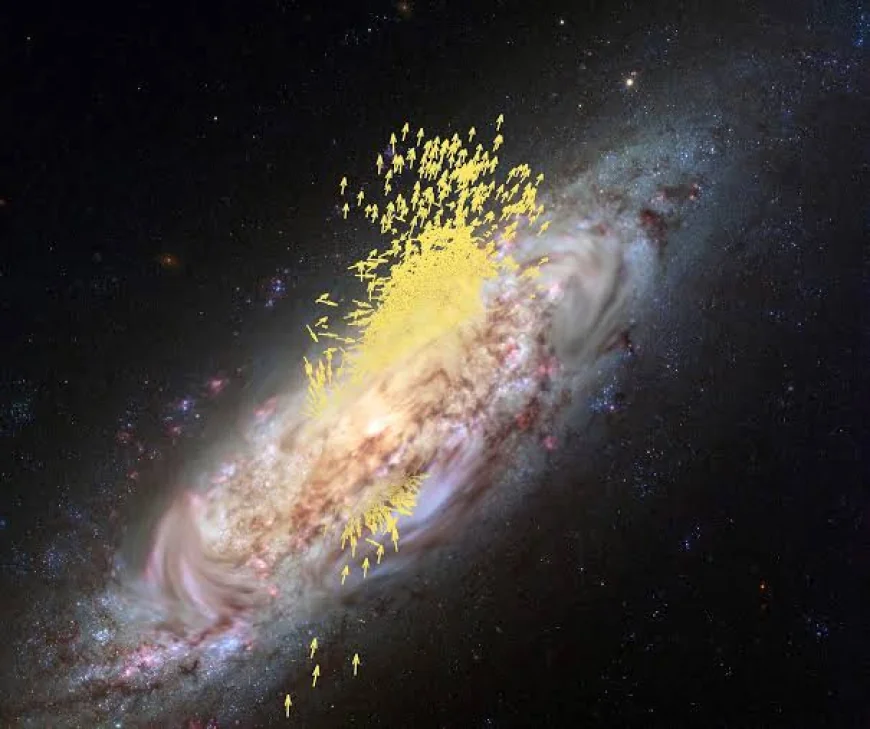
Astronomers from Durham University have uncovered groundbreaking evidence suggesting that our home galaxy underwent a violent, transformative event roughly 10 billion years ago, flipping completely on its side following a massive head-on collision with a dwarf galaxy. Presented at the Royal Astronomical Society's National Astronomy Meeting, the study reveals that the Milky Way was struck directly by an incoming interloper known as the Gaia Sausage (also referred to as Gaia-Sausage-Enceladus). While our galaxy ultimately tore the dwarf system apart and absorbed its remaining stars into the cosmic fold, the sheer, unimaginable chaos unleashed during the impact slowly reoriented the entire galactic disc by more than 90 degrees into the orientation we see today.
Solving the Mystery of the Stellar Halo
This remarkable discovery finally answers a long-standing astronomical puzzle regarding the Milky Way's sparse and unusual "stellar halo"—the ancient, diffuse cloud of stars orbiting far beyond the main galactic centre. While stars in the Milky Way's primary spiral disc spin around rapidly at a blistering 220 kilometres per second, stars within this mysterious outer halo crawl along at a sluggish 25 kilometres per second, moving almost in reverse relative to the rest of the galaxy.
Using cutting-edge supercomputer simulations from the renowned Auriga suite, the research team discovered that galaxies possessing such slowly rotating stellar haloes almost universally share two distinct characteristics:
-
They suffered a major, dead-centre head-on merger early in their evolutionary history.
-
They experienced a dramatic "disc flip" that fundamentally scrambled and reoriented their physical structure over the course of a few hundred million years.
A Turbulent Past and Our Place in Space
This ancient cosmic upheaval carries profound implications for our understanding of the universe, proving that the Milky Way's stars—and by extension, the very trajectory of our own Solar System—once travelled along entirely different paths through space. Rather than drifting through a calm, undisturbed neighbourhood for its entire lifetime, Earth's current cosmic address is the direct result of a violently reshaped galactic history. Furthermore, the findings highlight a deep, intimate evolutionary link between the glowing stars we can see and the surrounding invisible dark matter halo, giving scientists a thrilling new window into how massive galaxies assemble, collide, and survive across the vast expanse of deep time.
What's Your Reaction?
 Like
0
Like
0
 Dislike
0
Dislike
0
 Love
0
Love
0
 Funny
0
Funny
0
 Angry
0
Angry
0
 Sad
0
Sad
0
 Wow
0
Wow
0