
























Scientists Capture Ocean Floor Splitting Open as 160 Million Cubic Metres of Lava Erupt
Scientists have watched a seafloor spreading event unfold, seeing the ocean floor break apart and spew out 160 million cubic metres of lava, and have gained new insight into the Earth’s geological evolution.

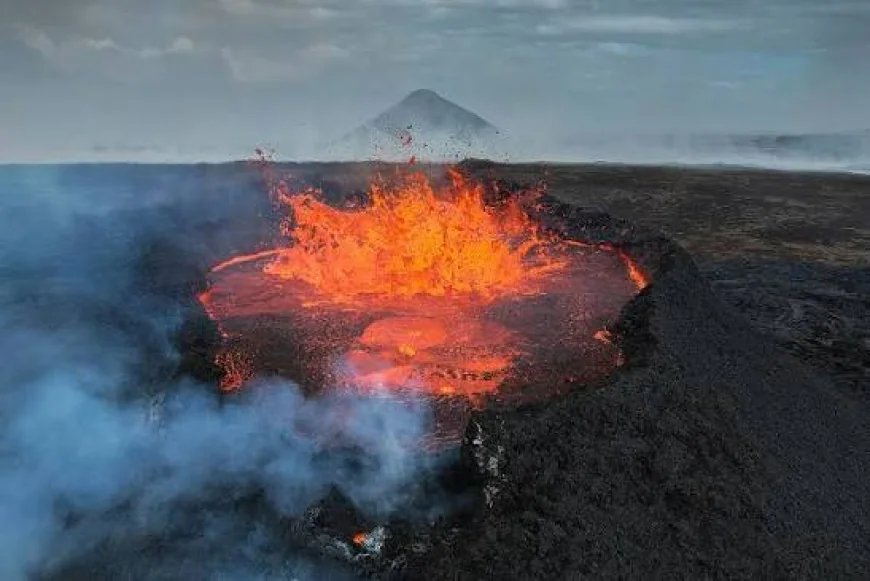
But because it happens thousands of metres below the ocean, we rarely get to witness it in action. Earth is always reconstructing its own surface, but then, scientists have achieved a geological first: they witnessed a “seafloor spreading” event in real time, seeing the ocean floor literally crack open and spew out an estimated 160 million cubic metres of lava.
The breakthrough study was published recently in the journal Nature.
How the Discovery Was Achieved
The historic event took place along the boundary between two deep-sea tectonic plates, where the Earth’s crust is slowly pulling itself apart.
Real-time monitoring: The researchers deployed a sophisticated network of underwater sensors and instruments directly along the rift zone.
Crust Formation As the tectonic plates pulled apart, superheated molten rock surged up from the depths of the Earth to fill the new void, cooling quickly to form new oceanic crust.
We already knew that this process created nearly 70% of the planet’s surface, but seeing it happen live made us realise that seafloor spreading is much faster and more dynamic than we’d previously thought.
Why This Changes What We Know
These eruptions are buried under huge ocean pressure and pitch-black depths, so geologists traditionally have had to rely on conjecture and post-eruption tracking.
Seeing the amount of lava and ground movement firsthand provides scientists with a better blueprint for how tectonic plates behave. The results will help scientists to better understand undersea earthquakes, map out volcanic hazards in the oceans, and track how our planet’s crust continues to evolve.
Scientists hope to build on that momentum, sending autonomous underwater vehicles and sophisticated sensors to take an even closer look at these active rift zones.
What's Your Reaction?
 Like
0
Like
0
 Dislike
0
Dislike
0
 Love
0
Love
0
 Funny
0
Funny
0
 Angry
0
Angry
0
 Sad
0
Sad
0
 Wow
0
Wow
0