





























AI Could Redefine Banking: RBI Governor Sanjay Malhotra Flags 7 Key Risks
RBI Governor Sanjay Malhotra says AI could fundamentally change banking and lending, but banks must adopt it responsibly. The RBI is focusing on human oversight, accountability and governance while warning about seven major AI-related risks.

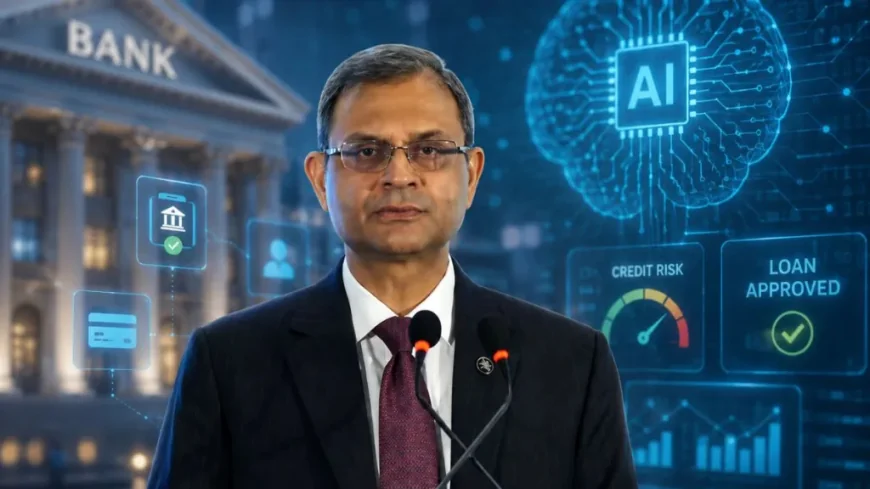
New Delhi: Artificial intelligence is rapidly moving from being a technology experiment to becoming a major part of the banking system, Reserve Bank of India (RBI) Governor Sanjay Malhotra said on Tuesday. He described AI as potentially a “new way of running a bank”, while stressing that its adoption must be accompanied by strong governance, accountability and human oversight.
AI Could Transform Lending Like UPI Changed Payments
Malhotra said AI has the potential to transform lending in the same way that the Unified Payments Interface (UPI) transformed digital payments. AI could help banks improve decision-making, personalise services, detect fraud and make financial services more efficient.
However, the RBI Governor cautioned banks against treating AI adoption simply as a race to deploy the latest technology. According to him, institutions that understand the technology and remain accountable for its outcomes are more likely to succeed in the AI era.
Human Oversight Must Remain Central
Malhotra stressed that technology cannot become an excuse for poor decisions. Banks must maintain meaningful human oversight when AI systems are involved in important financial decisions.
He warned that responsibility cannot simply be shifted to algorithms or technology providers when something goes wrong. AI should support human judgment rather than completely replace it, particularly in sensitive areas such as lending and customer services.
RBI Focuses on Responsible AI Governance
The RBI is pushing banks towards a structured governance framework for AI. This includes better understanding of the AI models being used, maintaining transparency and ensuring that institutions can explain and take responsibility for their technology-driven decisions.
The central bank has also highlighted the need for regulation and supervision to keep pace with rapid technological changes. Malhotra has previously said that digitalisation brings greater efficiency and access but also changes the speed and nature of risks facing the financial system.
Seven AI Risks on RBI’s Radar
The risks associated with AI include cybersecurity threats, data privacy concerns, algorithmic bias, inaccurate or unreliable outputs, lack of transparency, concentration and third-party dependency, and operational or systemic risks.
The RBI’s approach signals that India does not want to slow down financial innovation, but wants banks to adopt AI responsibly. With AI becoming increasingly embedded in banking, the challenge for financial institutions will be to balance innovation with customer protection, accountability and financial stability.
What's Your Reaction?
 Like
0
Like
0
 Dislike
0
Dislike
0
 Love
0
Love
0
 Funny
0
Funny
0
 Angry
0
Angry
0
 Sad
0
Sad
0
 Wow
0
Wow
0