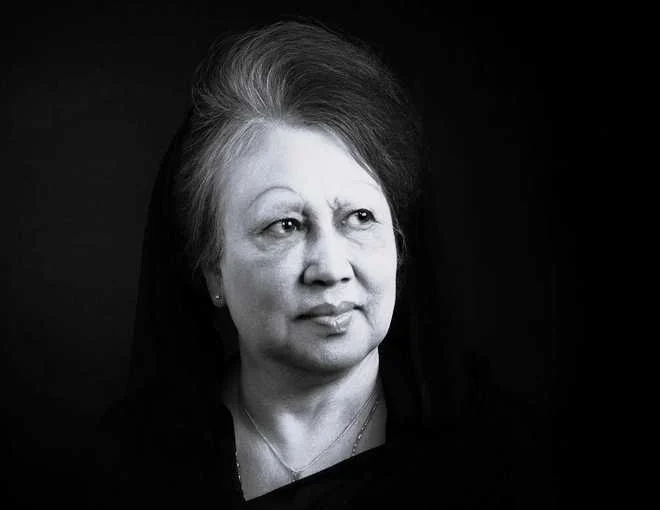
Dhaka/New Delhi, Dec 30 . Begum Khaleda Zia, Bangladesh’s former prime minister and a polarising figure in the country’s turbulent political life for more than three decades, died on Tuesday after a prolonged illness.
Zia who was born in Jalpaiguri, in present day West Bengal in 1945, turned 80 last August.
Earlier this month her son Tareque Rahman, who had gone into a self-imposed exile to the UK, had returned on Christmas Day to contest elections slated for February 2026 and be at her bedside as she was suffering from serious infections affecting her heart and lungs.
Her death was confirmed by the Bangladesh Nationalist Party (BNP), which she led as chairperson. She passed away at 6 am. at Evercare Hospital in Dhaka, where she had been undergoing treatment for the past five weeks.
In a statement, the BNP said: “The BNP Chairperson and former Prime Minister, Begum Khaleda Zia, passed away today at 6:00 am, shortly after the Fajr prayers.”
The funeral of late Begum Khaleda Zia will be held at Manik Mia Avenue in the capital on Wednesday.
Prime Minister Narendra Modi, expressed his sorrow over her passing, posting on X, “Deeply saddened to learn about the passing away of former Prime Minister and BNP Chairperson Begum Khaleda Zia in Dhaka.Our sincerest condolences to her family and all the people of Bangladesh.”
He added that her contributions to Bangladesh’s development and India-Bangladesh relations would always be remembered, recalling his meeting with her in Dhaka in 2015.
Sheikh Hasina, Chairperson of the Bangladesh Awami League, also expressed her condolences, noting, “Her contributions to the nation were significant and will be remembered. Her passing represents a profound loss for Bangladesh’s political life and for the leadership of the Bangladesh Nationalist Party.”
Hasina, once Khaleda Zia’s arch-rival who now lives in exile in India, also said, “I pray for the eternal peace and forgiveness of Begum Khaleda Zia’s soul and convey my sincere sympathies to her son, Tarique Rahman, and her family.”
Begum Zia’s death marks the end of an era and is likely to aid her party in its electoral efforts as voter sympathy for the dead leader, whose husband, Gen Zia Ur Rahman, was a freedom fighter and former military ruler of the country, is expected to surge.
Begum Zia served twice as prime minister, first from 1991 to 1996 and again from 2001 to 2006, becoming the country’s first woman to hold the office through a democratic election.
Alongside her long-time rival, Sheikh Hasina, she dominated Bangladesh’s political landscape, their feud shaping the nation’s politics for decades.
Reacting to her death, former Indian High Commissioner to Dhaka, Riva Ganguly Das, told ., “It’s the end of an era. We have worked with her even when she was in opposition.”
Ambassador Das pointed out that New Delhi had laid out the red carpet for her even when she was in the opposition and visited India. “Those who say we built relations with only one party are unaware of facts,” she said.
Begum Zia’s legacy, however, has her countrymen and women divided. Speaking of Begum Zia’s rise, exiled Bangladeshi poet and author Taslima Nasrin told ., “Begum Zia had a meteoric rise from being a simple housewife to becoming Prime Minister. She lacked nothing in her life except for the two years she spent in jail.”
Pointing out that a number of her books had been banned during Begum Zia’s reign, the celebrated author asked, “She banned many of my books, starting with Lajja … Will those bans be overturned now?”
Taslima Nasrin predicted that her son Tareque Rahman would win the polls. “Will that be good for us? I don’t know. But at least there will be an end to the chaos that we see now in Bangladesh.”
Begum Zia, the first woman to hold the office of prime minister in Bangladesh, left behind a country whose political contours she helped define, first as an unlikely symbol of resistance against military rule and later as a central actor in a fiercely adversarial, often unforgiving political arena.
For much of her early life, she lived in the shadows of her husband, Gen Zia-ur Rahman, the army officer-turned-president who was assassinated in a failed coup in 1981.
However, it was precisely that violent rupture, and the sudden leaderless drift of the Bangladesh Nationalist Party (BNP) that the General had founded, that propelled his, wife Begum Zia into the public arena.
At the time, few expected her to survive, let alone dominate, the jagged world of Bangladeshi politics. Senior BNP leaders, many of them seasoned politicians, doubted her capacity to lead.
Looming over it all was the formidable presence of Gen HM Ershad, who had seized power in a military coup and ruled the nation with an iron hand.
In the streets of Dhaka in the 1980s, she along with Sheikh Hasina, the “other Begum” who ruled Bangladesh she refused any accommodation with the Ershad regime.
Both leaders faced detentions and severe curtailment of their movements, while their supporters faced harassments and jail terms.
Her defining moment came in 1990, when, in a rare and historic gesture, she joined hands with her bitter rival Sheikh Hasina.
The alliance was tactical, uneasy and short-lived, but it proved decisive. Together, the two women, who would later dominate and polarise Bangladeshi politics for decades, forced Gen Ershad out of power.
The following year, in the 1991 general election, Begum Zia led the BNP to a surprise victory, becoming Bangladesh’s first female prime minister.
Her first tenure ended amid political turmoil, but in 1996 she played one of her most consequential, and least celebrated, roles. In a move that would shape Bangladesh’s electoral politics for years, her government passed the 13th Amendment to the Constitution, institutionalising a caretaker government system to oversee elections.
Then, in an act rare in South Asian politics, she dissolved parliament and resigned, choosing to contest the next election under the very neutral authority she had just created.
That election brought her rival, Sheikh Hasina’s Awami League to power.
Begum Zia returned to office once more in 2001, staging a dramatic comeback. Leading a four-party alliance, she secured a landslide victory, winning a two-thirds majority, in coalition with conservative Islamist parties, including the Jamaat-i-Islami Bangladesh, which had fought for Pakistan and against Bangladesh’s liberation.
That move deepened political and ideological fault lines in the country. Her premiership, in the 21st century, however, was overshadowed by the rise of militant extremism.
Groups such as Jamaat-ul-Mujahideen Bangladesh (JMB) and Ansar al-Islam Bangladesh gained prominence during this period, unleashing a wave of violence that shook the country. Critics accused her administration of complacency, and even patronage, charges her party consistently denied.
An army-backed government eventually took overin 2007 and held elections in 2008 bringing back Sheikh Hasina to power.
Legal battles, imprisonment, illness, and long periods of political isolation followed. Yet even diminished, she remained an enduring presence, invoked by supporters as a martyr of politics, and by critics as a relic of a confrontational era. . ./JRC .